Graphics/3D · EngineeringNov 2025
Road Rogue.
How far an AI-assisted pipeline can actually carry a game: Meshy for the assets, Codex for the logic, Three.js to tie it together.
Overview
A vibe-coded 3D chase game, built with AI tools
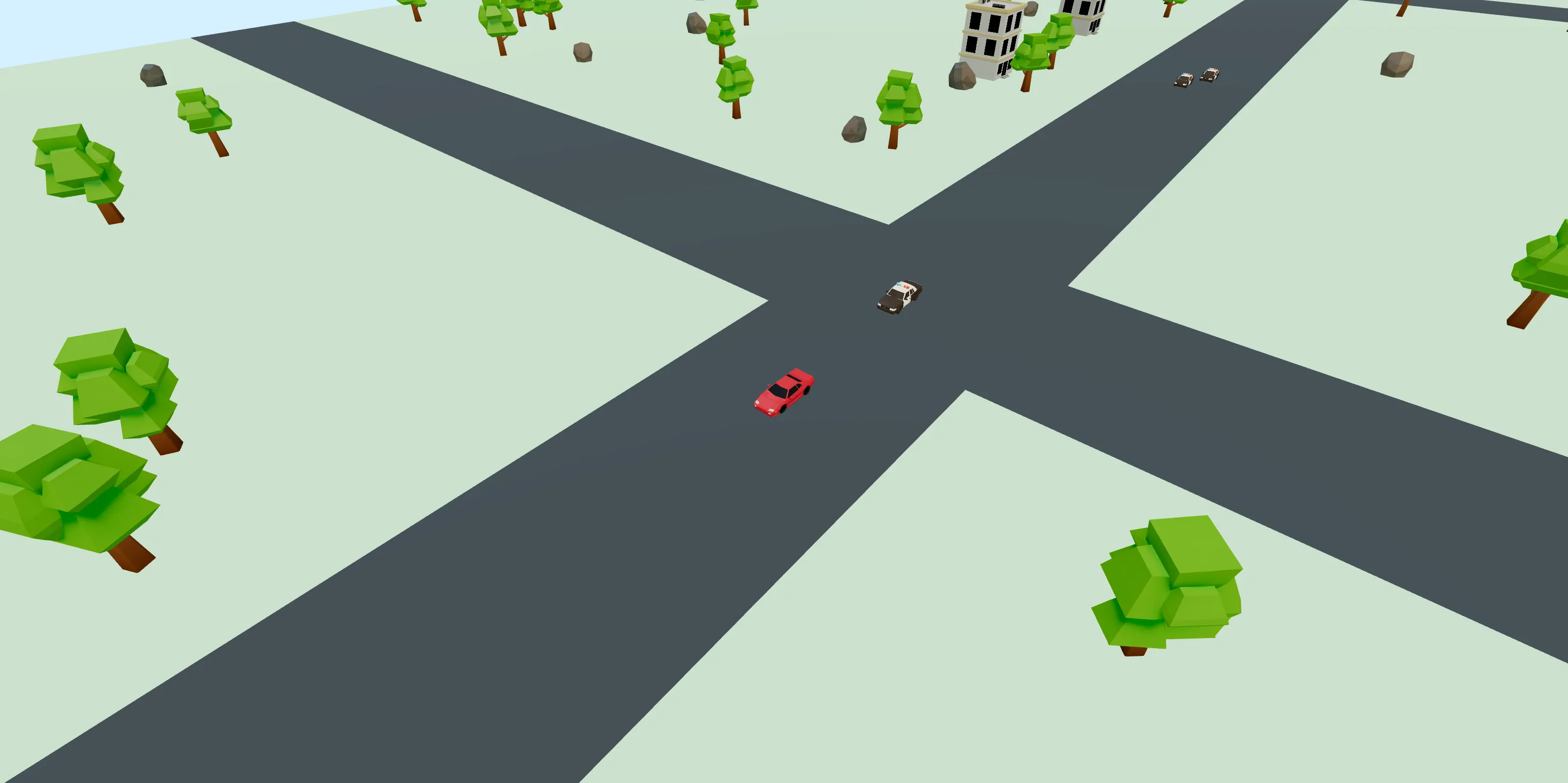
Road Rogue is a 3D car-chase game inspired by Smashy Road, built for a design course exploring AI-assisted creation. The brief was open: use AI tools to design and build something interactive. The result: a browser chase where you drive a getaway car through a low-poly city while police pursue you, surviving as long as you can.
It was fully vibe-coded, with 3D assets from Meshy (text-to-3D) and game logic scaffolded and debugged with Codex, wired together in Three.js. The workflow felt more like directing than programming: describe what you want, evaluate the output, steer toward something that feels good.
AI workflow
Meshy + Codex + Three.js
The tools shaped the process as much as the concept. Assets came from Meshy's text-to-3D pipeline: prompts described shape, style, and detail; several iterations per asset were generated and the best chosen, closer to art direction than modelling. Game logic (driving physics, police AI, collision, scoring) was scaffolded through Codex: describe a system in plain language, evaluate the generated code, find what's wrong, and re-prompt with tighter constraints.
Systems
- Driving: velocity- and friction-based movement so the car has weight; distinct acceleration, braking, and steering.
- Police AI: pursuit vehicles track the player with basic steering, spawning progressively as the score climbs.
- Procedural city: modular road and building blocks assembled at runtime, so each run has a different layout.
- Score & difficulty: a survival timer drives the score; police speed and spawn rate ramp as it rises.
Reflection
What vibe-coding actually teaches you
AI tools are great for getting to a first playable fast, but the part that makes it fun, the driving feel, still came down to hand-tuning. The real skill vibe-coding builds is evaluation: knowing what “good” looks like and steering toward it, because the tools will happily generate plausible-but-wrong just as easily as right.
By the numbers